
Introduction
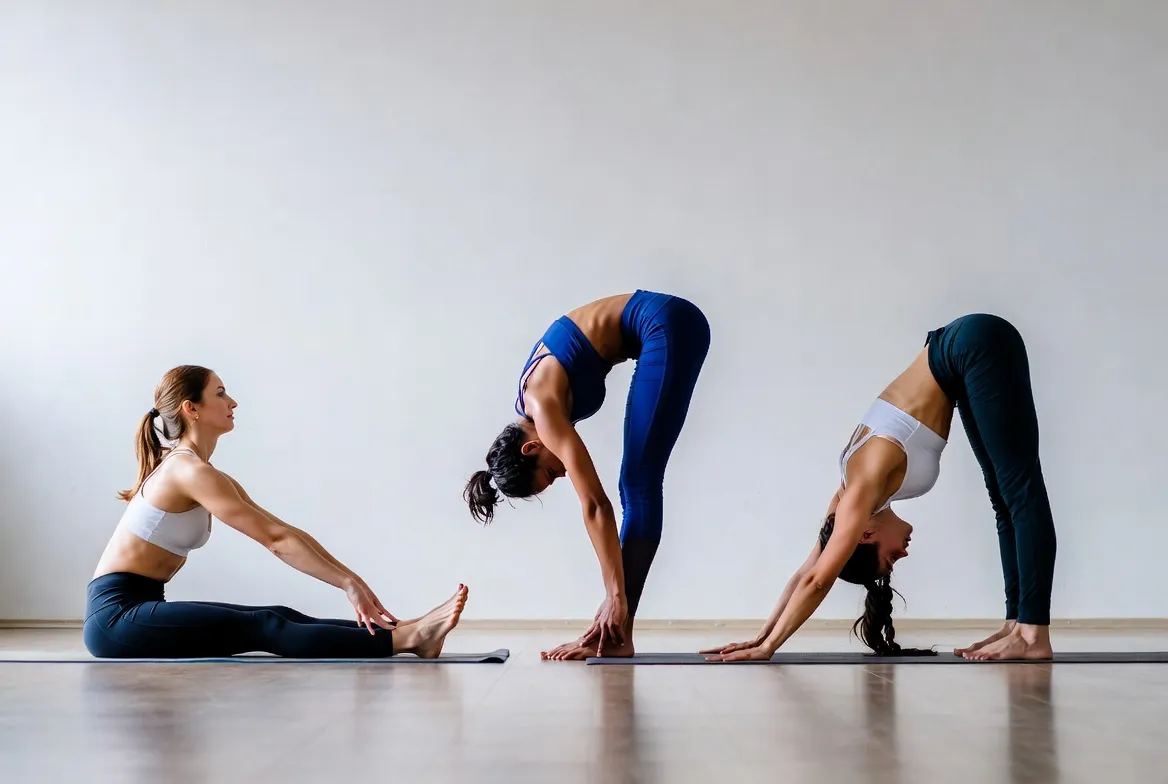
The Conventional view of yoga is that of a lonely practice or, at best, a practice in two persons. Nevertheless, the situation changes completely when three people are present in a yoga practice session. 3-person yoga poses bring an additional dimension of cooperation, mutual understanding, stability, and fun, which is scarcely reached when practising alone.
When doing yoga together, it is not about the aesthetically pleasing shapes that one can do to gain social media attention. Rather, it focuses on coordination, verbal communication, trust-building and movement. The responsibility assigned to each participant of the posture is significant, either in grounding, stabilising, guiding, or flowing. This interdependence renders trio yoga more gratifying on the physical level and emotionally satisfying.
When three individuals breathe, balance and move simultaneously, the nervous system reacts differently. The body is made more alert, the mind more present, and the experience seems related and not independent. This is the reason why trio yoga has been widely used in group classes, workshops, retreats, family yoga and teacher trainings.
This guide is designed for:
- Yoga instructors are creating interactive and engaging group sequences
- Parents and caregivers exploring safe, cooperative family yoga
- Friends and fitness partners looking for a fun and mindful activity
- Beginners curious about partner yoga without jumping into full acro yoga
What Are 3 Person Yoga Poses?
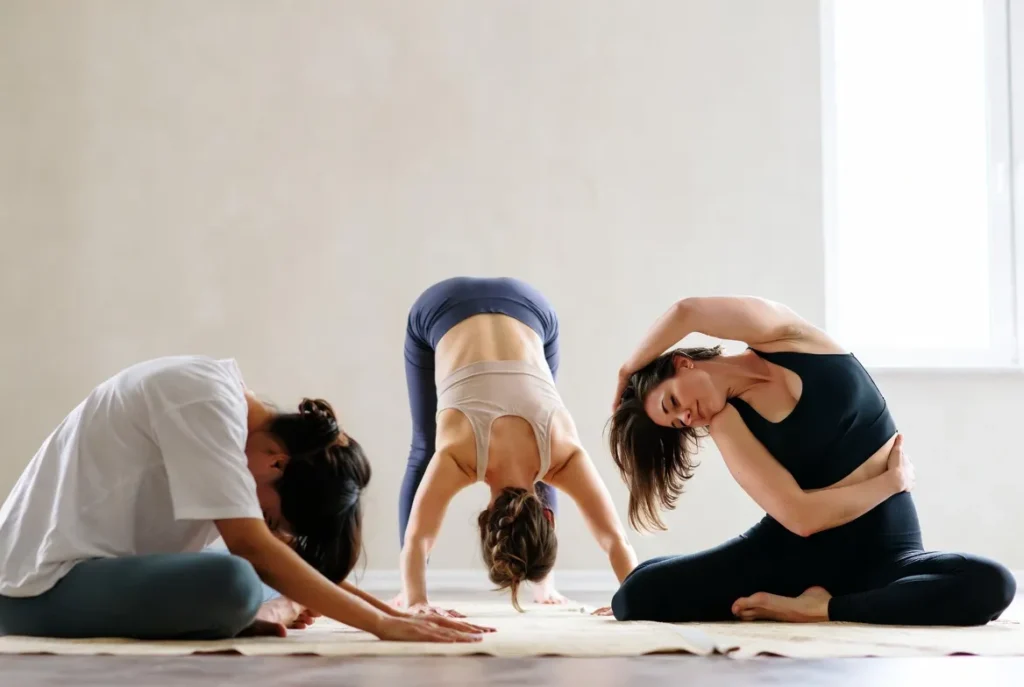
3-person yoga poses, also referred to as three-person yoga, trio yoga, or three-person acro-inspired yoga, are postures practised by three people working together in a coordinated and intentional way.
These poses typically involve:
- Shared balance and coordinated weight distribution
- Partner-assisted stretching and alignment support
- Group synchronisation through breath and movement
- Acro-style lifts and supported balances at higher levels
Unlike traditional solo yoga, trio yoga demands constant communication, awareness, and responsiveness. Each practitioner assumes a defined role, which may change from pose to pose.
Common Roles in Trio Yoga
- Base – Provides grounding, strength, and stability
- Supporter / Spotter – Assists with alignment, balance, and safety
- Flyer / Mover – Pushes off, puts in balance, or moves about.
- Such roles are dynamic and can be swapped, whereby every individual gets to sample the various physical and energetic roles.
Variations of Three-Person Yoga.
- Three-person yoga is flexible and versatile and can be used to attain different goals and populations:
- Relaxing and supportive trio yoga – suitable for beginners, the elderly, and families.
- Strength-based trio yoga- develops usable muscle in the trunk and extremities.
- Light-hearted and imaginative group yoga – ideal retreat and workshop.
Educational trio practice – assists with alignment learning by means of practical feedback.
Proper guidance helps 3-person yoga poses to be adjusted to almost any age/experience group.
The advantages of 3 Person Yoga Poses.
Physical Benefits
The three-person yoga pose provides a very diverse set of the body:
Improves balance, coordination and proprioception.
Gains stability and balance.
Makes legs, arms, shoulders, chest and spinal muscles stronger.
Promotes more intensive, secure extensions with support.
Enhances body awareness and movement.
Enhances flexibility and muscle strength.
Since the body is always trying to adapt to external support and collective balance, trio yoga develops functional power that is directly applied in the process of movement in everyday life.
Mental and Emotional Advantages.
In addition to physical training, trio yoga has a great attitude towards the mental and emotional sphere:
Establishes trust, sympathy, and collaboration.
Improves both verbal and non-verbal communication.
Promotes awareness and the here and now.
Relaxes with coordinated breathing and movements.
Builds trust, relationships, and strength of feeling.
Dancing together with the others assists in balancing the nervous system and developing a sense of belonging.
Social and Teaching Advantages.
In the case of yoga instructors and group leaders, 3-person yoga poses have special benefits:
Enhances relationships amongst friends, couples, and families.
Makes yoga less threatening and scary to beginners.
Promotes the sense of humour, interest, and imaginative discovery.
Perfect for group classes, children’s yoga, retreats, and team building.
Develops premium, viral experiences that drive involvement.
General Precautions of Practising Trio Yoga.
These are some of the key safety principles that should be observed before attempting any 3-person yoga pose:
It is always necessary to determine consent first before touching.
Warm up the body and particularly the shoulders, hips, spine, and core.
Use signals, such as ready, lift, and release.
Use aids like yoga mats, blocks, bolsters or blankets.
Progress gradually—avoid rushing into advanced shapes
Assign a spotter for balance or lifted poses
Practice on stable, non-slip surfaces
In trio yoga, safety is more important than aesthetics.
Safety Tips & Contraindications
Who Should Avoid Certain Trio Yoga Poses
Extra caution—or avoidance—is recommended for individuals with:
- Recent neck, spinal, or shoulder injuries
- Uncontrolled high blood pressure or heart conditions
- Post-surgical recovery limitations
- Pregnancy (avoid compression, inversion, or lifting poses)
When in doubt, consult a qualified yoga instructor or healthcare professional.
Important Safety Tips
- Never apply pressure to the neck or lumbar spine
- Maintain neutral joint alignment and soft knees
- Stop immediately if sharp or shooting pain occurs
- Use regressions and modifications generously
- Prioritise control, awareness, and breath over force
Breathing Technique for Trio Yoga
Breath synchronisation is a cornerstone of three-person yoga poses.
Recommended breathing approach:
- Inhale together to prepare and stabilise
- Exhale together to transition or lift
- Maintain slow, controlled nasal breathing
- Use breath cues to enter and exit poses safely
Unified breathing enhances balance, timing, and mutual awareness.
Muscles Targeted in 3 Person Yoga Poses
Trio yoga engages the entire body:
- Core muscles: abdominals, obliques, spinal stabilisers
- Lower body: quadriceps, hamstrings, glutes, calves
- Upper body: shoulders, arms, chest, upper back
- Stabilisers: ankles, hips, deep postural muscles
Because balance is shared, smaller stabilising muscles work more intensely than in solo practice.
25 Three-Person Yoga Poses (Beginner to Advanced)
Beginner Level 3 Person Yoga Poses
These poses are low-risk, ground-based, and slow-paced, making them ideal for beginners.
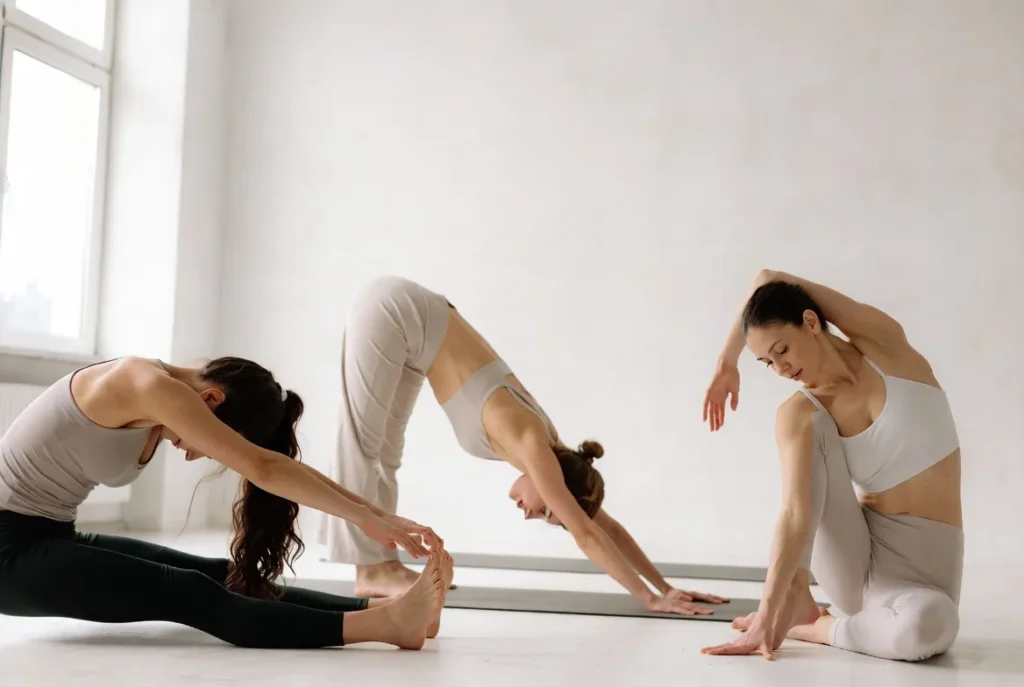
1. Triple Seated Forward Fold
- Targets: hamstrings, spine
- How to do it: Sit in a line with legs extended. Place your hands on your shoulders and hinge forward together.
- Common mistake: collapsing the chest
- Regression: individual seated forward fold
2. Triple Child’s Pose Circle
- Targets: hips, lower back
- How to do it: Sit in a circle, fold forward, arms reaching inward
- Pro tip: relax the neck and jaw
3. Triple Downward Dog
- Targets: Shoulders, calves
- How to do it: Two people form the Down Dog while the third gently supports the hips
- Safety tip: Avoid pressure on the lumbar spine
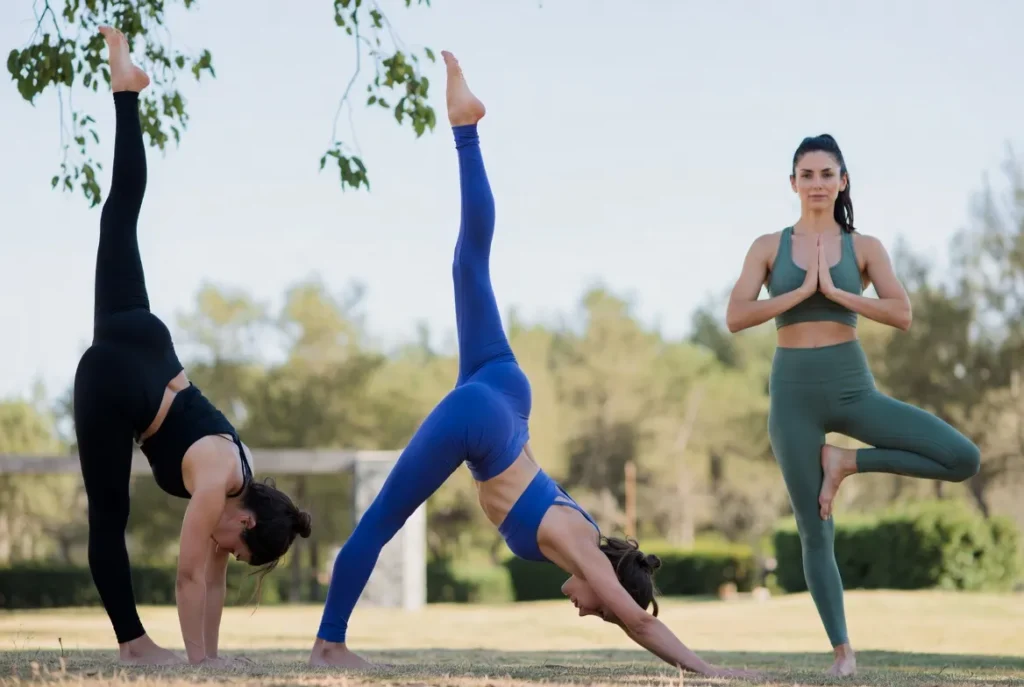
4. Three-Way Tree Pose
- Targets: ankles, balance
- How to do it: Stand in a triangle, press palms together
- Focus: steady gaze and even breath
5. Triple Cobra Pose
- Targets: chest, spine
- How to do it: Lie side by side and lift together
- Avoid: locking elbows or compressing the lower back
Intermediate Level 3 Person Yoga Poses
These poses introduce greater strength, coordination, and balance demands.
6. 3-Person Plank Pyramid
- Targets: core, shoulders
- Variation: knees down for support
7. Supported Warrior III
- Targets: legs, glutes, balance
- Cue: square hips and extend through the crown
8. Reverse Star Trio
- Targets: side body, chest
- Tip: open gradually without forcing
9. Seated Triangle Stack
- Targets: hips, spine
- Focus: length before depth
10. Flying Butterfly (Supported)
- Targets: hips, core
- Safety: Use a spotter at all times
(Poses 11–20 continue with progressive difficulty, emphasising alignment, trust, and controlled transitions.)
Advanced Level 3 Person Yoga Poses
These poses are acro-inspired and should only be practised by experienced practitioners.
21. Triple Acro Pyramid
- Targets: full body
- Warning: trained practitioners only
22. Flying Archer Trio
- Targets: legs, shoulders
- Tip: engage the core before lifting
23. Triple Shoulder Stand (Supported)
- Contraindication: neck or spinal issues
24. Three-Person Handstand Prep
- Tip: wall support is strongly recommended
25. Trio Balance Flow
- Goal: smooth transitions with breath control
20-Minute 3 Person Yoga Routine
| Time | Activity |
| 0–5 min | Warm-up and mobility |
| 5–10 min | Beginner trio poses |
| 10–15 min | Strength and balance |
| 15–18 min | Playful acro |
| 18–20 min | Cool-down and relaxation |
Pros & Cons of 3 Person Yoga Poses
Pros
- Builds trust and cooperation
- Enhances strength and balance
- Fun, engaging, and memorable
- Ideal for families and groups
Cons
- Requires space and coordination
- Higher injury risk without guidance
- Not suitable for all health conditions
Tips for Beginners
- Begin with floor-based poses
- Partner with similar strength levels
- Practice on cushioned surfaces
- Prioritise alignment over appearance
Yoga Philosophy Behind Group Practice
In yogic philosophy, Sangha (community) supports growth and awareness. Trio yoga embodies this principle by emphasising connection, mutual support, and shared intention rather than individual performance.
FAQs
Yes, when practised with proper warm-up, communication, and progressions.
Absolutely. Start with simple poses and avoid lifts.
Yes, with adult supervision and playful modifications.
Only for advanced poses. Beginner trio yoga does not require acro experience.
Conclusion
3-Person Yoga Poses blend movement, mindfulness, and human attachment into a uniquely powerful practice. When approached with awareness and patience, trio yoga cements the body, ploughs trust, and creates a joyful shared minute.
This is not just a simple pose book but a powerful resource as it provides easy-to-understand directions, frameworks of safety, progressions and organisation, empowering professionals and teachers alike.
Be it in practice with your friends, leading group classes or family yoga, trio yoga reminds us that we learn more and have a richer experience when we learn together.
Explore more expert yoga resources on theyogafitness.com
Share this guide with your yoga partners
Begin your trio yoga journey—one mindful breath at a time
