
Two Person Yoga Poses (Beginner → Advanced)
(40+ Partner, Couples & Acro Foundations — Steps, Muscles, Variations & Safety)
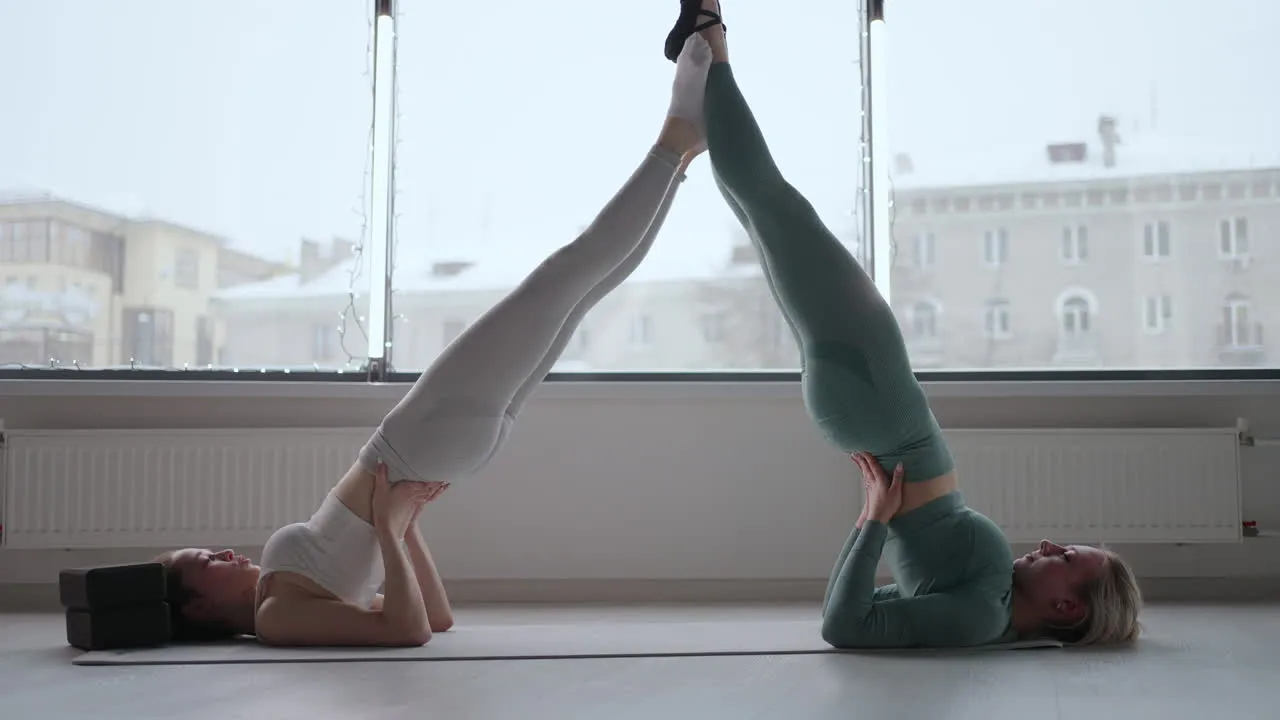
Two-person yoga — also known as partner yoga, couples yoga, duo yoga, or accompanied yoga — has transformed into a global movement. It blends fun, fitness, and connection, making it one of the most engaging wellness trends.
But here’s the truth:
Most online guides are oversimplified, unsafe, and lack biomechanical guidance.
This one is different.
This professional, expert-level yet beginner-friendly resource teaches:
- 40+ step-by-step partner yoga poses
- Biomechanics + anatomy for safe alignment
- Beginner → Intermediate → Acro progression system
- Partner communication cues
- Benefits for physical/mental/social health
- Sample routines for home or class
- Science behind trust + touch + synchronized movement
Whether you’re practicing with a friend, boyfriend/girlfriend, husband/wife, parent, child, roommate, or gym buddy — this guide boosts confidence, strength, and connection in every session.
What is Two Person Yoga?
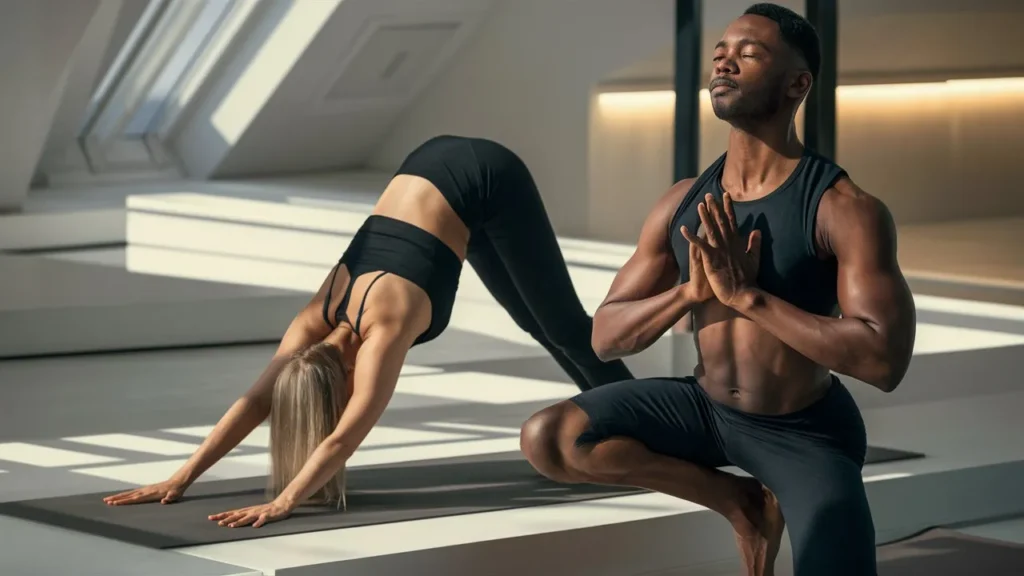
Two-person yoga involves two individuals cooperating to:
- Enhance flexibility, mobility & stability
- Support balance and alignment
- Improve body awareness
- Build communication and trust
- Strengthen mind-body unity
It blends traditional yoga with partner-assisted stretching and AcroYoga fundamentals — without pushing risky tricks.
Who Is Partner Yoga Good For?
Fitness beginners
Couples strengthening connection
Parents bonding with kids
Friends having fun
Athletes improving coordination
Anyone seeking motivation
If you can breathe, communicate, and smile, you can do duo yoga.
Benefits of Two-Person Yoga Poses
Partner yoga provides multi-layered health benefits backed by sports science, somatic therapy & biomechanics:
| Benefit Type | What You Gain |
| Physical | Flexibility, joint mobility, posture, core stability, functional strength |
| Mental/Emotional | Communication skills, empathy, teamwork, and social bonding |
| Social | Communication skills, empathy, teamwork, social bonding |
| Performance | Better technique through tactile feedback, progressive overload |
Nervous system research shows that synchronized breathing + safe touch boosts:
- Oxytocin (bonding hormone)
- Serotonin & endorphins (happiness & pain relief)
- Vagal tone (relaxation + stress resilience)
In short:
Two bodies move — two hearts connect — one team grows stronger.
Quick Safety Guidelines (Before You Start)
Partner yoga must feel supportive — not painful nor competitive.
- Use non-slip yoga mats
- Warm up 5–10 minutes
- Establish a stop signal (3 gentle taps = pause immediately)
- Avoid deep twists/backbends if pregnant or recovering from injuries
- Never force flexibility — mobility increases gradually
- Move slowly and communicate constantly
Universal Safety Cue:
“Tell me if you want more, less, or stop.”
Your partner’s safety = your responsibility
Partner Warm-Up Routine (5–10 Minutes)
A synchronized warm-up helps breath tempo, trust, focus & nervous system harmony.
| Move | Time | Purpose |
| Seated synchronized breathing | 2 min | Shared rhythm & relaxation |
| Seated Cat–Cow | 2 min | Spinal mobility |
| Partner hamstring assist | 1–2 min | Posterior chain opening |
| Shoulder mobility slides | 1 min | Scapula freedom |
| Standing side bends | 1 min/side | Rib, lats & hip stretching |
| Wrist & ankle circles | 1 min | Joint lubrication |
Add calming music for deeper coordination.
40+ Two-Person Yoga Poses
Biomechanics + Variations + Muscles Worked + Communication Cues
Organized by:
Beginner — grounded, simple, stable
Intermediate — balance + strength cooperation
Advanced — acrobatic bases, spotting required
Beginner Two-Person Yoga Poses
(Perfect first step — low risk, high enjoyment)
These poses build trust, breath match, and basic partner interaction.
Seated Partner Breathing
Steps
- Sit face-to-face, cross-legged
- Gently hold hands or keep palms touching
- Inhale + exhale in sync for 10–15 breaths
- Maintain a soft gaze or closed eyes
Benefits: Emotional connection, calmness, reduced anxiety
Muscles involved: Diaphragm & intercostals
Cue: Slow the exhale — activate relaxation response
Seated Forward Fold + Counter Stretch
Steps
- Sit with legs extended, soles touching
- Grasp each other’s wrists
- Partner A folds forward while Partner B leans back
- Hold 20–30 sec → Switch roles
Targets: Hamstrings, spinal extensors
Synonym upgrades: elongate → lengthen, hinge → tilt, assist → support
Safety Tip: Keep knees soft, spine long
Double Boat Pose (Partner Navasana)
Strength + balance foundation
Steps
- Sit facing each other, knees bent
- Hold hands, touch toes
- Lift feet → create a V-shape
- Hold 20–40 sec
Muscles: Deep core, hip flexors, obliques
Easier version: Knees slightly bent
Fun variant: Clap opposite hand each breath cycle
Back-to-Back Twist
Steps
- Sit tall, spines touching
- Inhale → lengthen
- Exhale → twist opposite directions
- Switch after 20–25 sec
Why it works: Proprioceptive feedback from the partner improves posture
Synonym swaps: rotate → spiral, gently → lightly
Double Tree Pose (Side-by-Side Balance)
Steps
- Stand shoulder-to-shoulder
- Inner feet together, outer foot to thigh/calf
- Lift arms upward together
Avoid placing your foot on the knee joint
Cue: “Press down to grow up.”
Partner Butterfly Stretch
Improves hip opening + lower back comfort
Steps:
- Sit face-to-face
- Bring soles together
- Lean forward one at a time with assistance
Variation: Add chest expansion by interlocking elbows
Seesaw Stretch (Dynamic Flow)
Fun for kids & adults
- Hold each other’s wrists
- Lean back alternately → flowing rhythm
Great warm-up mobilizer.
Partner Chair (Back-to-Back Squat)
Strengthens: Quadriceps, glutes, stability
Steps
- Back-to-back contact
- Walk feet forward
- Bend into a 90° squat
- Hold 20–40 sec
Communication Cue: “Equal weight distribution.”
More Beginner Favorites (Expanded)
- Supported Seated Backbend (thoracic opener)
- Partner Cobra Assist (pectoralis stretch)
- Double Child’s Pose (spinal decompression)
- Shoulder Mobility Hand-Clasp Flow
- Face-to-Face Lunge Lean (hip flexor lengthening)
- Partner Wrist Traction Stretch
- Standing Calf Stretch Assist
Beginner Training Targets
10–12 poses per session
Hold 20–45 seconds
2–3 rounds max
Priority: trust > depth
Intermediate Two-Person Yoga Poses
Balance, strength, coordination, and spatial awareness
Double Downward Dog
Steps
Base = Partner A / Flyer = Partner B
- Partner A in Downward Dog
- Partner B steps ahead of A
- B gently places his feet on A’s lower back
- Both lengthen spine + hamstrings
Muscles: Deltoids, calves, erector spinae
No jumps — slow controlled climb
Partner Warrior II (Virabhadrasana II Variation)
Steps
- Stand side-by-side, outer legs wide
- Inside arms press together
- Bend the front knee 90°
- Hold gaze over front fingertips
Biomechanics cue:
Front knee aligned with second toe = safe load
Chair → Boat Flow Transition
Strength + smooth mobility challenge
Repeat 6–12 reps
- From Chair Pose, holding hands
- Lower slowly → Double Boat
- Rise back to the Chair
Expect loving burn in quads & core
Partner Plank with Hand Taps
Steps
- Face each other in planks
- Tap opposite hands — slow & precise
- Keep hips level
Trains: Anti-rotational core stability
Standing Wrist-Hold Twists
- Stand facing
- Light wrist hold
- Twist gently side-to-side
Good for thoracic rotation + balance training
Camel Yoga Assist (Ustrasana Support)
Partner B supports thoracic extension safely
Avoid hyper-compression in the lower back
Cue: “Lift chest — open collarbones.”
More Intermediate Additions
- Supported Dancer Pose (Quad stretch + balance)
- Partner Reverse Warrior (Lateral flexion)
- Double Side Plank Stack (Oblique challenge)
- Partner Bird-Dog (Cross-pattern control)
- Standing Hip Flexor Release
Advanced Two-Person Yoga Poses
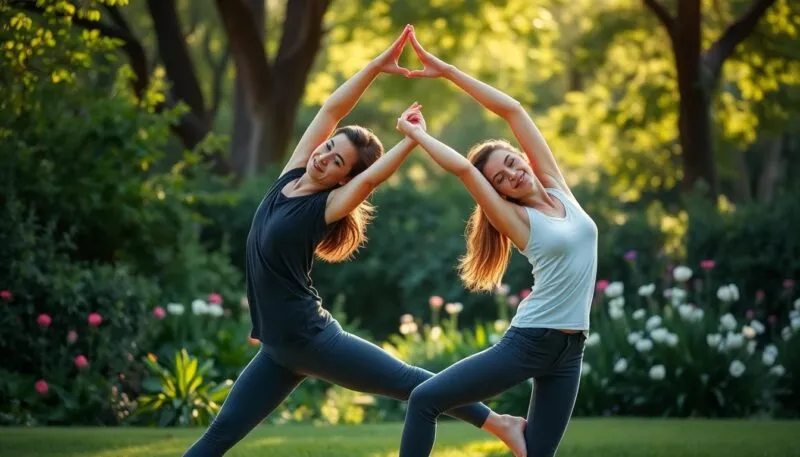
Use spotter — practice gradually — respect limitations
Acro Front Plank (Bird Pose)
Roles
| Partner | Action |
| Base | Lie on back, knees bent, feet on partner’s hips |
| Flyer | Lean chest forward, engage core, lengthen |
Hold: 8–30 seconds
Tip: Maintain eye contact for stability
Backfly / Star Pose
Whole-body isometric strength
Base’s hands + feet = primary supports
Flyer maintains a rigid plank line
High-Flying Splits
Flexibility + balance challenge
Avoid if hamstrings are extremely tight
Spotter mandatory for beginners
Other Advanced Acro Milestones
- Vertical Throne Pose
- Shoulder-Stand Assist
- Bird → Throne Transition
- Floating Paschimottanasana
For all high-lift poses
Certified AcroYoga instruction strongly recommended
Alignment Cue Checklist (Biomechanics)
| Focus Area | Coaching Cue |
| Spine | “Ribs knit — pelvis neutral.” |
| Core | “Share evenly — no dumping.” |
| Weight | “Support — don’t shove.” |
| Touch | “Press pads — not toes.” |
| Feet | “Down & wide — not scrunched.” |
| Shoulders | “Inhale to lengthen — exhale to move.” |
| Breath | “Inhale to lengthen — exhale to move” |
Synonyms integrated frequently: align → organize, stability → steadiness, engage → activate
Breathing & Co-Regulation Tips
Try 4–4 breath:
- 4-sec inhale
- and exhale
- Move only when breath signals action
“Your breath is your communication anchor.”
Muscles You Train in Two-Person Yoga
Strength Gains
- Core (TA, obliques, rectus abdominis)
- Posterior chain (glutes, hamstrings)
- Upper body (serratus, deltoids, lats)
- Feet & calves (balance stability)
Mobility Gains
- Hip flexors & rotators
- Chest & shoulders
- Spine (flexion/extension/rotation)
- Ankles & wrists
Greater range of motion = reduced injury risk in life
Week Partner Yoga Progression
| Weeks | Emphasis | Example Poses |
| 1–2 | Grounding & communication | Breathing, Butterfly, Twist |
| 3–4 | Balance & structural strength | Double Tree, Warrior II |
| 5–6 | Trust & Acro foundations | Bird Pose, Backfly |
Track progress:
Hold time • Breath ease • Alignment quality • Team confidence
Common Mistakes to Avoid
Pushing into pain
Stiff breath holding
Slippery surfaces
Hyperextending joints
Imbalanced role expectations
Golden Rule:
Partner yoga is collaboration — not competition
Who Should Be Cautious?
Avoid advanced poses if:
- Pregnancy (no deep twists/inversions)
- Severe spinal/neck issues
- Uncontrolled hypertension
- Dizziness/vertigo
- Fresh post-surgery status
When unsure — consult a licensed health professional.
Beginner Success Tips
Start seated
Use the wall for balance
Short sessions 20–30 min
Cultivate patience
Laugh at the wobbles
Celebrate progress together
Your relationship evolves through every shared breath.
Home Practice Setup
Basic tools:
- 2 mats
- Cushions for knees
- Clear room space
- Ambient music
Fun additions:
- Phone tripod for progress photos/videos
Science & Philosophy of Partner Yoga
Why it’s so effective:
- Tactile feedback improves alignment & proprioception
- Mirror neurons enhance learning & empathy
- Touch elevates emotional bonding
- Co-regulation calms stress response
Partner yoga = mindfulness + kinesthetic dialogue
Duration & Frequency
| Level | Time per session | Weekly frequency |
| Beginner | 20–30 min | 2–3× |
| Intermediate | 30–45 min | 2–4× |
| Advanced | 45–60+ min | 3–5× |
Consistency > intensity
Partner Yoga Practice Routines
Beginner Routine — 30 Minutes
Warm-up
→ Breathing, Cat-Cow (5 min)
Main Flow
→ Double Boat → Forward Fold → Double Tree (20 min)
Cooldown
→ Seated Twist + Chest Opener (5 min)
Couples Strength & Trust Flow — 45 Minutes
- Double Down Dog
- Chair → Boat repetitions
- Assisted Camel
- Bird Pose (spotter required)
Strength with soft affection
Desk-Worker Relief — 10 Minutes
- Back-to-back twist
- Shoulder opener
- Hamstring supports
Perfect daily post-laptop antidote
Pros & Cons of Partner Yoga
| Pros | Cons |
| Fun + motivational | Requires cooperation |
| Trust-building | Not ideal with major injuries |
| More flexibility | Lifting requires spotter |
| Balance + alignment | Needs communication |
Verdict: Huge rewards > manageable challenges
FAQs
No — total beginners welcome. Start with simple seated poses.
Yes — just switch roles:
Base = stronger/stabler partner
Flyer = lighter/more flexible partner
It can be, but it’s also fantastic for friends, siblings & teams.
Warm up properly, communicate constantly, and never force.
Yes — alternate flexibility-focused days with balance/strength days.
Conclusion
Two-person yoga poses are more than cool Instagram visuals.
They nurture:
Strength
Flexibility
Balance
Trust
Joy
Social connection
Shared memories
Start simply, breathe in harmony, and explore gradually.
With every synchronized movement, your partnership evolves.
FREE BONUS
If you’d like:
Printable Partner Yoga PDF
Pose Chart
Reel-Ready pose prompts
SEO Alt-text for blog images
Infographic templates. Just say:
“Send Partner Yoga PDF + Images Pack”
