
Introduction
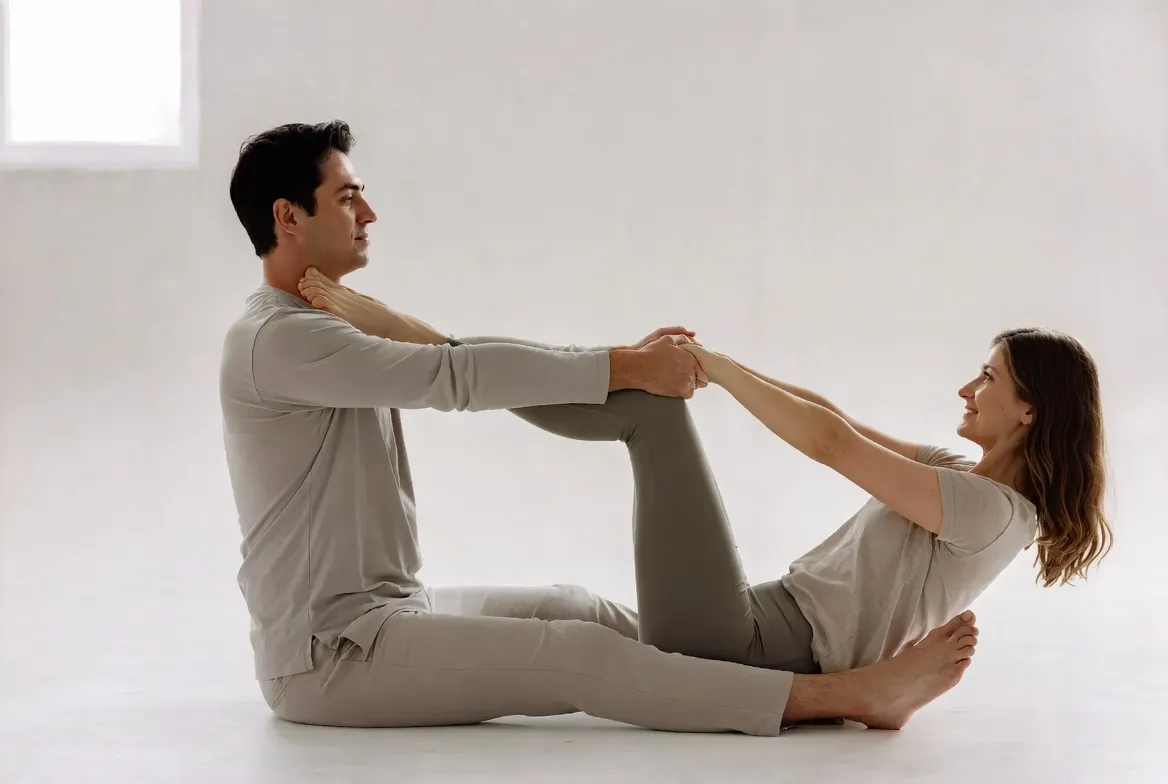
With quick and busy timetables, most partners struggle to stop and take a breath and reconnect in an authentic sense. The quality time spent together is normally slowed down by working hours, distractions from using the computer, and day-to-day chores. Couples yoga (Also known as Partner Yoga) is a conscious method of couples reconnecting with each other, at physical, emotional, and mental levels.
Partner yoga is unlike personal yoga practice and is centered on collective consciousness, coordinated movement, helping each other, and conscious interaction.
Each pose is a dialogue between two bodies. You breathe in unison, out in unison, straighten up in unison, and loosen together. Even simple positions, like sitting back-to-back and matching breath, will develop calmness, compassion, and intimacy.
According to scientific research on the physical activities of partners, it is possible to increase motivation, decrease cortisol, increase emotional intimacy, and feel better about the relationship with a partner in the case of joint exercises. These benefits are enhanced when yoga is performed as a couple by means of mindfulness, controlled breathing, flexibility training, and muscular involvement. It is no longer something to put on a to-do list but rather purposeful quality time.
The other benefit is accessibility. No prior yoga experience, extraordinary flexibility, or physical training is required. Couples yoga is non-discriminatory – it is open to all, including married couples, dating partners, long-term companions, and even close friends. The postures can be increased and decreased according to comfort and capability. This detailed manual features 25 yoga couple poses with step-by-step directions, advantages, and safety tips, modifications of poses, a routine, muscle information, and commonly asked questions. All is written in understandable and easy-to-read English, and you know and are safe during your common practice.
What Is Couples Yoga?
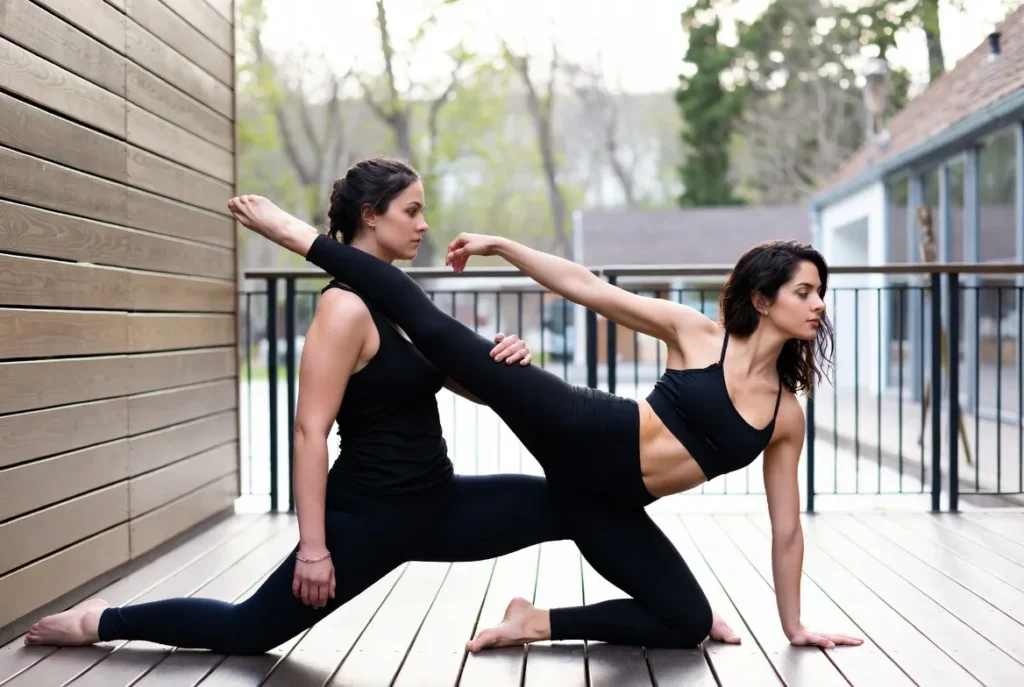
Couples yoga is a type of yoga in which two people do poses together by use of connection technique, resistance technique, balance technique, or mirroring technique. The partners can assist each other physically and energetically and be in a stable state of breath and consciousness. Even though there is a tendency to consider couples yoga as a way of relationships, it is also efficient when one practices with friends, siblings, or family members.
Key Characteristics of Couples Yoga
Involves an intentional physical contact, i.e., hand-to-hand, foot-to-foot, back-to-back,k or shoulder contact.
Lays emphasizes communication, credibility, agreement, and respect.
Allows the advantage of safer and deeper stretches under partner guidance.
Increases balance, muscle endurance, coordination, and posture.
Very versatile for every level of learning of the yoga notion: beginner, intermediate, and advanced.
Couples yoga has been confused with acro yoga, but they are different practices. Acro yoga pays much attention to lifts, inversions, and aerials. In comparison, couples yoga tends to be stable, slow, controlled, and stability-based, with connection and safety being the main factors as opposed to performance or spectacle.
Benefits of Couples Yoga
- The frequency of practice of couples yoga is more of a holistic experience that goes beyond the mat.
Physical Benefits
- Greater efficiency, pliability, and joint range of motion.
- Improved core stability, power of legs, and upper body strength.
- Better body awareness, alignment, and balance.The capability of deepening levels with regulated external support.
- Less muscular tightness, stiffness, and imbalance in the posture.
Mental & Emotional Benefits
- Lower stress levels through synchronized breathing patterns
- Improved focus, presence, and mental clarity
- Enhanced emotional regulation and patience
- A stronger sense of relaxation and nervous system balance
Relationship Benefits
- Encourages cooperation instead of competition
- Strengthens trust through giving and receiving support
- Improves verbal cues and nonverbal understanding
- Creates shared wellness habits and meaningful rituals
- Adds joy, novelty, and playfulness to fitness routines
Over time, couples yoga transforms exercise into a shared mindful experience that strengthens both the body and the bond.
General Rules for Practicing Couples Yoga Safely
Before exploring any partner yoga poses, keep these foundational safety principles in mind.
1. Communication Comes First
- Establish simple cues such as “stop,” “ease,” “hold,” or “okay.”
- Never push, pull, or force a partner into a posture
- Maintain consistent verbal and physical check‑ins
2. Warm Up Together
- Dedicate 5–10 minutes to gentle warm‑up movements
- Include neck mobility, shoulder rolls, hip circles, and spinal waves
- Integrate slow breathing to prepare muscles and joints
3. Respect Different Skill Levels
- Strength, balance, and flexibility may vary between partners
- Choose poses appropriate for the less experienced participant
- Progress gradually and mindfully
4. Use Props When Needed
- Yoga blocks, straps, cushions, blankets, or a wall enhance safety
- Props support alignment and reduce strain
5. Exit Poses Slowly
- Avoid abrupt transitions or sudden releases
- Maintain control and support during pose exits
25 Couples Yoga Poses (Step‑by‑Step Guide)
Each couple’s yoga pose below includes:
- Level
- Step‑by‑step instructions
- Benefits
- Modifications
- Common mistakes
1. Seated Partner Breathing
Level: Beginner
Hold: 1–3 minutes
How to do it:
Sit back‑to‑back in a comfortable seated position. Close your eyes. Inhale together for four counts, feel the backs expand, then exhale together for four counts.
Benefits:
- Calms the nervous system
- Enhances emotional awareness and connection
Common Mistakes:
- Forcing breath synchronization
- Collapsing posture
Modification:
Sit on a folded blanket for spinal support.
2. Seated Partner Forward Fold
Level: Beginner
Hold: 5–8 breaths
Sit facing each other with legs extended in a wide V. Hold forearms or wrists. One partner gently folds forward while the other offers controlled resistance.
Benefits:
- Lengthens hamstrings and spine
- Teaches safe assisted stretching
Modification:
Bend knees or use a yoga strap.
3. Twin Tree Pose
Level: Beginner → Intermediate
Hold: 5–8 breaths
Stand side‑by‑side with inner arms touching. Lift outer legs into Tree Pose and press palms together.
Benefits:
- Improves balance and concentration
- Builds mutual stability
Modification:
Keep toes lightly grounded.
4. Back‑to‑Back Chair Pose
Level: Beginner
Hold: 20–30 seconds
Stand back‑to‑back. Slowly bend knees and lower into Chair Pose, using equal pressure for support.
Benefits:
- Strengthens quadriceps and glutes
- Reinforces teamwork
5. Partner Boat Pose
Level: Intermediate
Hold: 6–10 breaths
Sit facing each other, hold hands, lift feet, and balance together.
Benefits:
- Builds deep core Engagement
- Improves coordination
Modification:
Keep one foot grounded.
6. Seated Spinal Twist
Level: Beginner
Sit back‑to‑back. Inhale to lengthen, exhale to rotate gently.
Benefits:
- Enhances spinal mobility
- Relieves back tension
7. Standing Partner Forward Fold
Level: Beginner
Stand facing each other, hold hands, hinge at the hips, and fold.
Benefits:
- Stretches the posterior chain
- Encourages trust
8. Double Warrior II
Level: Intermediate
Stand in opposite Warrior II stances while lightly holding hands.
Benefits:
- Strengthens legs and hips
- Builds focus
9. Partner Plank (Supported)
Level: Intermediate
One partner holds Plank while the other places their hands on the shoulders for stability.
Benefits:
- Upper‑body and core strength
10. Double Downward Dog
Level: Intermediate
One partner holds Downward Dog while the other applies gentle pressure to the hips.
Benefits:
- Shoulder and hamstring stretch
11. Partner Camel Pose (Supported)
Level: Intermediate
One partner performs Camel Pose while the other supports the lower back.
Benefits:
- Opens chest and shoulders
12. Partner Pigeon Pose (Gentle)
Level: Beginner → Intermediate
One partner performs Pigeon while the other offers light hip support.
Benefits:
- Deep hip release
13. Temple Pose
Level: Beginner
Stand facing each other, hands on shoulders, lean forward together.
Benefits:
- Chest and shoulder stretch
14. Double Child’s Pose
Level: Beginner
Sit back‑to‑back in Child’s Pose.
Benefits:
- Encourages relaxation
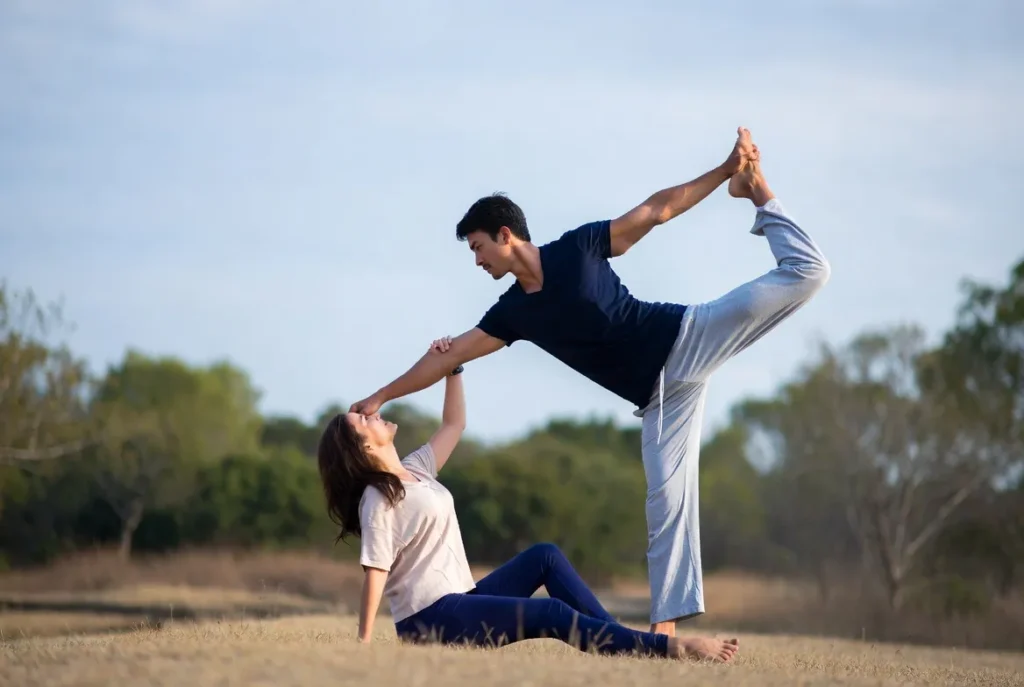
15. Royal Dancer for Two
Level: Intermediate
Hold one foot each and hinge forward together.
Benefits:
- Balance and flexibility
16. Partner Bridge Pose
Level: Intermediate
One partner lifts into the Bridge while the other supports the hips.
Benefits:
- Strengthens the posterior chain
17. Standing Counter‑Balance
Level: Beginner → Intermediate
Hold hands and lean back evenly.
Benefits:
- Improves balance and core strength
18. Partner Lunge Stretch
Level: Beginner
One partner lunges while the other stabilizes the hips.
Benefits:
- Hip flexor stretch
19. Double Fish Pose
Level: Intermediate
Sit back‑to‑back and recline onto elbows.
Benefits:
- Chest opening
20. Partner Twist with Foot Hold
Level: Intermediate
Sit facing each other, hold feet, and twist gently.
Benefits:
- Spinal mobility
21. Partner Balance Squat
Level: Intermediate
Hold hands and squat together.
Benefits:
- Leg endurance
22. Supported Wheel Pose (Advanced)
Level: Advanced
One partner supports the back during Wheel Pose.
Benefits:
- Deep spinal extension
23. Acro‑Style Star Pose (Advanced)
Level: Advanced
The base lies down while the flyer balances.
Benefits:
- Trust and strength
24. Partner Hip Opener Stretch
Level: Beginner
Sit facing each other and Gently press your knees outward.
Benefits:
- Hip mobility
25. Shared Savasana
Level: Beginner
Lie side‑by‑side holding hands.
Benefits:
- Deep relaxation and bonding
3 Ready‑to‑Use Couples Yoga Sequences
Beginner 10‑Minute Warm‑Up
- Partner Breathing
- Twin Tree Pose
- Back‑to‑Back Chair Pose
- Seated Forward Fold
- Shared Savasana
Romantic 20‑Minute Flow
- Breath Sync
- Partner Forward Fold
- Double Downward Dog
- Partner Boat Pose
- Supported Bridge
- Reclined Chest Opener
- Hand‑Holding Savasana
Strength‑Focused 30‑Minute Practice
- Partner Plank
- Double Warrior II
- Partner Boat Variations
- Supported Lunges
- Cool‑Down Stretches
20‑Minute Couples Yoga Routine (Minute‑by‑Minute)
| Time | Pose |
| 0–2 | Partner Breathing |
| 2–6 | Twin Tree + Chair |
| 6–10 | Forward Fold + Twist |
| 10–15 | Boat + Downward Dog |
| 15–18 | Supported Bridge |
| 18–20 | Savasana |
Muscles Targeted in Couples Yoga
- Core: abdominals, obliques
- Legs: quadriceps, hamstrings, glutes
- Back: spinal stabilizers
- Upper body: shoulders, arms
- Hips: flexors, adductors
Breathing Technique for Partner Yoga
- Inhale together to prepare
- Exhale during exertion
- Maintain nasal breathing
- Avoid breath retention
Common Mistakes to Avoid
- Skipping warm‑ups
- Forcing flexibility
- Lack of communication
- Ignoring discomfort
- Rushing transitions
Safety Tips & Contraindications
Avoid or modify couples yoga if you have:
- Recent spinal injury
- Chronic neck or back pain
- Raised blood pressure.
- Pregnancy (no abdominal pressure)
- See the professional in case of doubt.
Tips for Beginners
- Start with seated poses
- Use non‑slip mats
- Practice 15–20 minutes
- Focus on connection
Yoga Philosophy and Science of Couples Yoga.
The word yoga means union. This principle can be traced in the case of couples yoga, whereby a bond is created between two individuals due to breathing together, awareness, and communication. The usefulness of coordinated breathing is the activation of the parasympathetic nervous system, which results in relaxation and emotional stability.
FAQs
Yes. Many poses are beginner‑friendly.
1–3 times per week.
Yes. It supports communication and trust.
No. Poses are adaptable.
Conclusion
Couples Yoga is not only a physical practice, but a common ceremony of power, faith, being, and bonding. Togetherness helps to nurture patience, empathy, and support.
You do not need perfection. Start small, keep even, and have fun. Even 20 mindful minutes a few times per week can make one more flexible and less stressed, as well as more emotionally connected.
Ready to begin? To discover more yoga information on TheYogaFitness.com, print a workout, and share this guide with someone with whom you would like to practice.
