
Introduction: Why This Lenovo Yoga S740 Review Matters in 2026
For more than a decade, ultrabooks have been marketed around a familiar promise:
- Ultra-slim profiles
- Lightweight construction
- Reliable Everyday Speed
- Long-lasting battery life
- Quiet, refined operation
- Premium aesthetics
The Lenovo Yoga S740 was engineered to embody this vision. At launch, it represented a near-perfect compromise between elegance and capability—a machine designed for professionals who wanted power without carrying a bulky laptop.
Fast forward to 2026, and the computing landscape has evolved dramatically.
Modern ultrabooks now benefit from:
- More efficient CPU architectures
- Smarter power management
- Improved thermal engineering
- Longer battery endurance
- Integrated AI acceleration
- Better cooling without added noise
Despite these advancements, search interest for the Yoga S740 remains surprisingly strong. Why?
Because:
- It is widely available at reduced prices
- Refurbished and open-box units are common
- The design still looks modern
- Many existing reviews are outdated
- Buyers want to know if it still holds up
That is exactly why this updated review exists.
The Problem With Most Lenovo Yoga S740 Reviews Online
Most articles and videos about the Yoga S740 suffer from one major flaw: they were written at launch.
They often focus on:
- Initial benchmark scores
- Factory-fresh battery life
- Short testing sessions
- Marketing claims rather than long-term usage
What they rarely address:
- Heat buildup after hours of work
- Clock speed drops over time
- Fan behavior during sustained load
- Battery degradation
- Real-world multitasking
- Modern software demands
This Lenovo Yoga S740 review (2026) corrects those gaps.
What This Review Focuses On
Long-term daily performance
Thermal throttling patterns
Battery life consistency over the years
Modern software compatibility
Who should still buy it in 2026
Who should avoid it entirely
This is not a spec-sheet rewrite.
This is a real-world evaluation.
What Is the Lenovo Yoga S740?
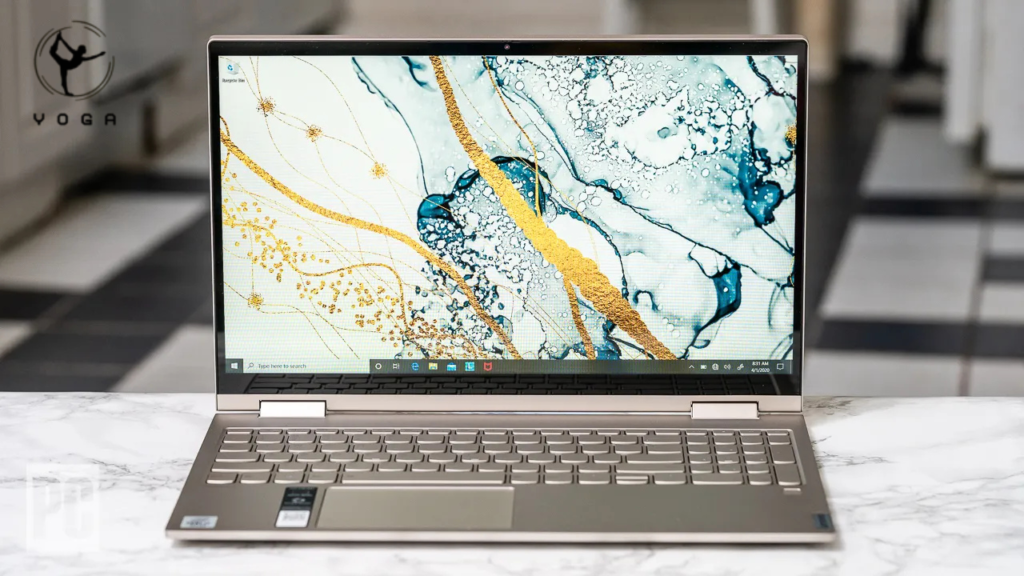
The Lenovo Yoga S740 is a premium clamshell ultrabook that belongs to Lenovo’s Yoga S-series, a lineup designed to emphasize sophistication, portability, and visual quality.
Important Clarification
This is NOT a 2-in-1 laptop
Despite the “Yoga” branding, the S740 does not feature:
- A 360-degree hinge
- Tablet mode
- Touch-first design
Instead, it is a traditional laptop built around balance rather than versatility.
Core Design Philosophy
The Yoga S740 was created with specific priorities in mind:
- A slim, refined aluminum body
- High-resolution display options
- Lightweight portability
- Comfortable typing experience
- Quiet thermal behavior
What Lenovo intentionally deprioritized:
- Sustained peak performance
- Upgrade flexibility
- Aggressive cooling systems
This design choice defines both the strengths and weaknesses of the device in 2026.
Target Audience: Who the Yoga S740 Is Made For
Best Suited For
- Office professionals
- Remote and hybrid workers
- University and college students
- Business travelers
- Writers and researchers
- Casual content consumers
- Light creative users
Not Designed For
- Hardcore gamers
- Video editors working with 4K timelines
- 3D artists and animators
- Software developers with large builds
- Data scientists and engineers
- Users seeking long-term future proofing
Specifications & Features: Complete Breakdown
Core Hardware Configurations
| Component | Details |
| Processor | Intel 10th Gen Core i5 / i7 |
| Graphics | Intel Iris Plus or NVIDIA MX250 |
| Memory | 8GB–16GB LPDDR4X (soldered) |
| Storage | NVMe SSD (256GB–1TB) |
| Display | 14″ FHD or 4K HDR Dolby Vision |
| Ports | Thunderbolt 3, USB-C, USB-A, audio |
| Weight | Approx. 1.4 kg |
| OS | Windows 10 / Windows 11 |
Critical Note for 2026 Buyers
RAM is permanently soldered
This single factor dramatically affects long-term usability.
- 8GB models feel restrictive in modern workflows
- 16GB variants are strongly recommended
- RAM cannot be upgraded later
In 2026, memory capacity matters more than raw CPU speed for everyday responsiveness.
Real-World Performance Review (2026 Perspective)
CPU Performance & Daily Productivity
On paper, Intel’s 10th-generation processors appear serviceable. In practice, performance depends heavily on workload duration.
Short-Burst Tasks (Strength)
For brief operations, the Yoga S740 still feels responsive:
- Web browsing with many tabs
- Office productivity software
- Email and communication apps
- Cloud-based tools
- Light photo retouching
- Small development tasks
Applications open quickly, transitions are smooth, and system lag is minimal—especially on 16GB configurations.
Sustained Workloads (Weakness)
Problems emerge when workloads extend beyond short bursts.
After approximately 5–10 minutes of continuous CPU stress:
- Clock speeds begin to decline
- Power limits are reduced
- Heat builds near the hinge
- Performance stabilizes at a lower level
This is classic thermal throttling.
Practical Impact
- Long exports take significantly longer
- Large spreadsheets slow down
- Continuous compiling loses speed
- Extended multitasking becomes less fluid
The Yoga S740 prioritizes thermal safety and acoustics over raw output.
Graphics Performance & Light Gaming
Some configurations include the NVIDIA MX250 discrete GPU, which offers a modest graphical advantage over integrated graphics.
Playable Scenarios
- CS:GO (low to medium settings)
- Rocket League (reduced settings)
- Older esports titles
- Casual indie games
Not Recommended For
- Modern AAA games
- GPU-intensive rendering
- Extended gaming sessions
Thermal limitations affect both the CPU and GPU during longer play sessions, leading to noticeable FPS drops.
Thermals & Performance Throttling (What Most Reviews Ignore)
This is where age becomes most apparent.
Observed Thermal Behavior
- CPU temperatures approach 90°C under load
- Fans remain relatively quiet
- Heat concentrates near the hinge area
- The keyboard center becomes warm
- Palm rests remain comfortable
Throttling Pattern Simplified
- Initial performance boost
- Rapid heat accumulation
- Clock speed reduction
- Stabilized lower performance
Why This Matters in 2026
Modern software is more demanding, even for basic tasks. Sustained workloads that were manageable in 2020 now push this system to its limits.
Battery Life Test: Real-World Results
Battery longevity is one of the Yoga S740’s most discussed traits—and also one of the most misunderstood.
Realistic Battery Performance
| Usage Scenario | Average Battery Life |
| Web browsing & documents | 9–11 hours |
| Video streaming (FHD) | 8–9 hours |
| Photo editing | 6–7 hours |
| Gaming | 2–3 hours |
Influencing Factors
- Display resolution (4K drains ~30% faster)
- Background applications
- Brightness levels
- Battery wear on used units
Charging Performance
USB-C fast charging
~80% charge in under 60 minutes
Still competitive by 2026 standards.
Display Quality & Multimedia Experience
One of the Yoga S740’s strongest advantages.
FHD vs 4K HDR Comparison
| Feature | FHD | 4K HDR |
| Sharpness | Good | Outstanding |
| Brightness | Solid | Higher |
| Battery Impact | Lower | Higher |
| Color Accuracy | Very Good | Excellent |
Display Strengths
- Dolby Vision support
- Wide viewing angles
- High contrast ratios
- Ideal for streaming platforms
- Excellent for casual creative work
The glossy finish can reflect light outdoors, but indoor usage is excellent.
Design, Build & Overall User Experience
Build Quality
- CNC-milled aluminum chassis
- Minimal flex
- Premium tactile feel
- Still modern in 2026
Keyboard & Trackpad
- Comfortable key spacing
- Quiet, soft keystrokes
- Responsive trackpad
- Excellent for long writing sessions
Ports & Connectivity
- Thunderbolt 3 remains useful
- Limited USB-A availability
- No SD card reader
Webcam & Audio
- Webcam: Average quality
- Speakers: Clear, well-balanced
Adequate for meetings and casual entertainment.
Pros & Cons (Balanced Overview)
Pros
Elegant lightweight design
Excellent display quality
Smooth everyday performance
Thunderbolt 3 support
Quiet operation
Cons
Thermal throttling
Aging CPU platform
Soldered memory
Limited port selection
Reduced battery life on 4K models
Yoga S740 vs Competitors
Compared to:
- Dell XPS series
- HP Spectre lineup
- Acer Swift range
| Category | Yoga S740 | Modern Competitors |
| Design | Excellent | Excellent |
| Performance | Average | Better |
| Thermals | Weak | Improved |
| Used Value | Strong | Higher cost |
Key Takeaway
The Yoga S740 only makes sense at the right price.
FAQs
Only for light or older titles. Thermal limits reduce long-session performance.
It manages heat by lowering performance rather than becoming dangerously hot.
Typically 8–11 hours, depending on usage and display resolution.
Yes—but only at a discounted or refurbished price.
Final Verdict
The Lenovo Yoga S740 remains a refined ultrabook that still excels in areas many users care about:
- Display Quality
- Portability
- Build materials
- Typing comfort
- Day-to-day smoothness
However, its limitations are more visible than ever.
Thermal throttling restricts sustained output, and newer ultrabooks offer better efficiency, cooler operation, and longer battery life.
Buy It If
You prioritize design and portability
Your workload is light to moderate
You find a well-priced refurbished unit
You choose the 16GB RAM version
Avoid It If
You need sustained performance
You game or edit videos frequently
You want long-term future-proofing
Explore more Lenovo Yoga reviews, buying guides, and in-depth comparisons on theyogafitness.com before making your final decision.
