
Introduction
Ashtanga Yoga is one of the most transformative, influential, and enduring systems in the modern yoga world. Built on structure, rhythm, and breath-linked movement, it is both Disciplined and Dynamic, offering a pathway that unites the mind, body, and breath into a powerful, meditative flow. This practice is renowned for its sequential postures, energising breathwork, internal heat, and steady progression — elements that help practitioners cultivate strength, mobility, resilience, and mental clarity with remarkable consistency.
This comprehensive pillar guide serves as your complete reference for understanding, learning, and practising Ashtanga Yoga. You will explore the origins, key principles, Primary Series breakdown, breath and bandha techniques, Mysore vs led classes, modifications, contraindications, physical and mental benefits, common mistakes, alignment cues, dietary recommendations, and a structured 8-week beginner roadmap.
If you’re searching for a clear, friendly, expert-level explanation of Ashtanga Yoga without confusion or complication, this guide is for you. By the time you finish reading, you’ll have a solid understanding of how the system works and exactly how to begin practising safely, confidently, and consistently.
Let’s dive into the timeless practice that has empowered, strengthened, and inspired millions worldwide.
What Is Ashtanga Yoga? (Origins & Principles)
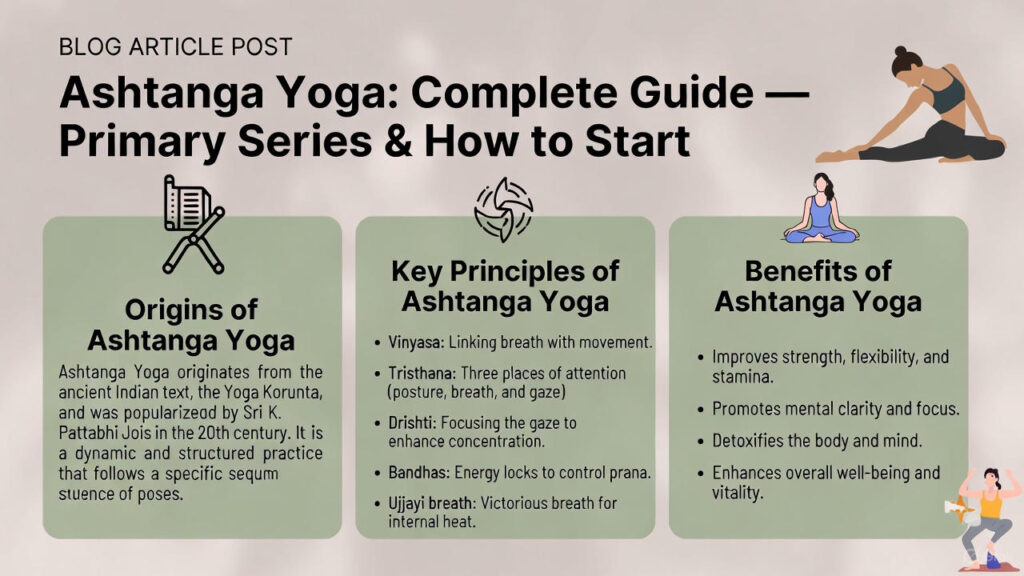
Ashtanga Yoga is a structured, vinyasa-based, breath-synchronised system developed and popularised by Sri K. Pattabhi Jois of Mysore, India. Unlike traditional yoga styles that vary daily, Ashtanga follows a fixed sequence of poses, allowing practitioners to track growth, build discipline, and deepen internal focus over time. Each movement is coordinated with Ujjayi breath, bandhas (internal locks), and drishti (focused gaze), creating a flowing meditation that strengthens both body and mind.
Key Principles of Ashtanga Yoga
Here are the essential pillars:
- Vinyasa — movement united with breath
- Ujjayi breath — slow, ocean-like respiration
- Three bandhas — energetic locks that stabilise the body
- Drishti — intentional eye focus
- Fixed sequences — repeated daily for mastery
- Progressive learning — one pose prepares the next
This structure helps practitioners build discipline, sharpen awareness, and develop internal heat (tapas), which supports purification and physical conditioning.
Unlike general Vinyasa classes, which shift according to the teacher, Ashtanga always follows the same blueprint — a design that boosts consistency, stability, and long-term progression.
The Jois Lineage & Mysore Tradition
The Ashtanga method has its roots in the teachings of Tirumalai Krishnamacharya, often called the “father of modern yoga.” Pattabhi Jois studied under him and later codified the Ashtanga method into an organised, sequential system that is now practised globally.
Today, thousands of practitioners worldwide follow the Mysore-style tradition — the original way Ashtanga was taught in Mysore, India.
What Is the Mysore Method?
A Mysore-style class is unlike any typical yoga session. Instead of following the teacher in a synchronised flow, each student practices individually, moving at their own pace.
Mysore Class Features
- Self-paced movement
- Individualised adjustments and support
- Gradual addition of new poses
- Highly beginner-friendly
- Allows students to build confidence safely
Many assume Mysore is only for advanced yogis, but the opposite is true — Mysore is the most accessible, personalised, and foundational way to learn Ashtanga Yoga correctly.
How Ashtanga Works: Breath, Bandhas & Vinyasa
To understand Ashtanga fully, you must understand its three core components: breath, internal locks, and movement synchronisation.
Ujjayi Breath (Breathing Technique)
Ujjayi breath is a slow, rhythmic, whisper-like breathing technique created by narrowing the throat slightly. It:
- Generates heat
- Stabilizes energy
- Calms the nervous system
- Supports endurance
- Creates consistency
The soft, ocean-like sound also becomes a meditative anchor for the mind.
Bandhas (Internal Energy Locks)
Bandhas are subtle yet powerful muscular engagements that stabilise the body and direct energy upward.
Three Bandhas
- Mula Bandha — Root lock; pelvic floor activation
- Uddiyana Bandha — Abdominal lock; lower belly drawn inward
- Jalandhara Bandha — Throat lock; used mostly in pranayama
Together, these locks cultivate stability, lightness, and energetic flow.
Vinyasa (Breath-Synchronised Movement)
Each movement in Ashtanga aligns with a specific breath — creating a continuous “moving meditation.” This link enhances heat, coordination, rhythm, and mindfulness.
The Primary Series (Yoga Chikitsa): Overview & Purpose
The Primary Series, known as Yoga Chikitsa or “Yoga Therapy,” is designed to cleanse, strengthen, and align the body. Practitioners move from warming sequences to standing, seated, and finishing postures systematically.
Primary Series Breakdown
1. Sun Salutations (Surya Namaskar A & B)
Purpose:
- Warm and lubricate muscles
- Increase heat and circulation
- Connect breath and movement
Standard practice includes:
- 5 rounds of Surya Namaskar A
- 3 rounds of Surya Namaskar B
2. Standing Sequence
Common poses include:
- Padangusthasana
- Trikonasana
- Parsvakonasana
- Prasarita Padottanasana
Benefits:
- Builds grounding
- Strengthens legs
- Improves balance
- Enhances stability
3. Seated Sequence
Key postures include:
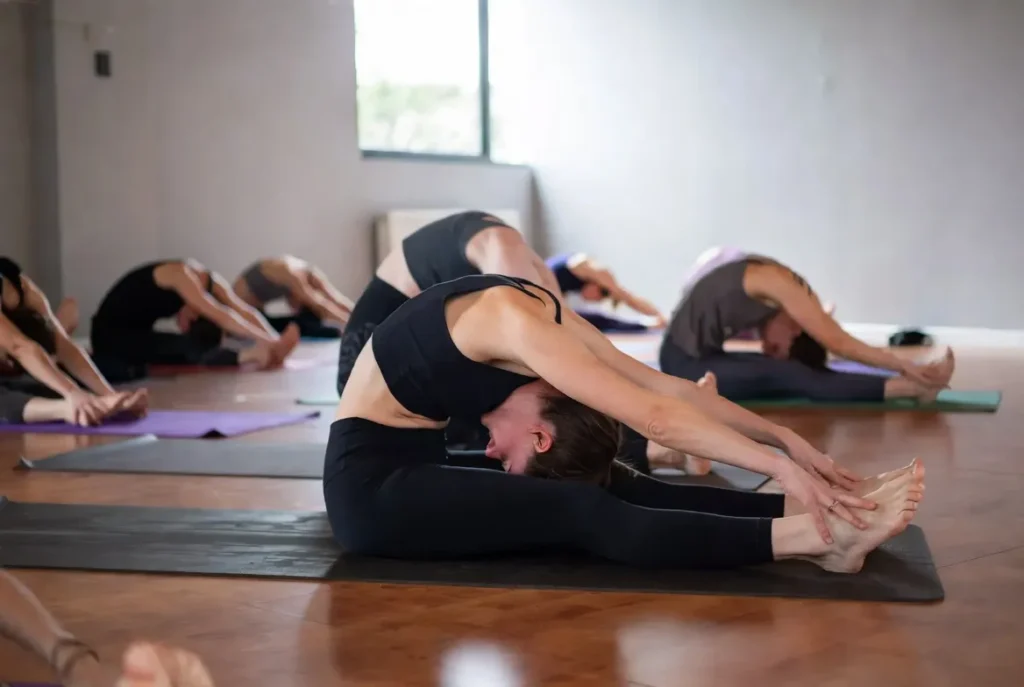
- Paschimottanasana
- Janu Sirsasana
- Marichyasana A–D
Benefits:
- Hip mobility
- Hamstring flexibility
- Deep forward-folding skills
- Twisting and detoxification
4. Finishing Sequence
Postures include:
- Shoulderstand
- Headstand preparation
- Bridge pose
- Early lotus preparation
Purpose:
- Cool the nervous system
- Balance energy
- Lead toward meditation
Benefits of Ashtanga Yoga (Physical, Mental & Emotional)
Ashtanga Yoga is a full-spectrum system that develops strength, stamina, flexibility, and emotional resilience.
Physical Benefits
- Improved muscular strength
- Enhanced flexibility in the hips, spine, and hamstrings
- Cardiovascular conditioning
- Stronger core and posture
- Joint mobility
- Improved digestion
- Detox through heat and perspiration
Mental & Emotional Benefits
- Reduces anxiety
- Sharpens concentration
- Builds determination and discipline
- Creates inner calm
- Strengthens mind-body awareness
- Improves mood stability
Long-Term Benefits
- Stronger bones
- Enhanced metabolic function
- Better sleep quality
- Emotional resilience
- Long-lasting focus
Who Should (and Shouldn’t) Practice Ashtanga Yoga — Contraindications & Modifications
While Ashtanga is accessible, some individuals need modifications or extra care.
Good Candidates
- People who like routine
- Individuals seeking a challenge
- Yogis wanting strength + flexibility
- Athletes wanting mobility
Practice With Modifications if You Have
- Knee issues
- Low back discomfort
- High blood pressure
- Wrist or shoulder sensitivity
- Chronic fatigue
Avoid or Seek Medical Clearance if You Have
- Severe spinal disorders
- Recent surgery
- Uncontrolled hypertension
- Pregnancy (unless experienced)
Mysore vs Led Ashtanga: Which Is Better?
| Feature | Mysore Style | Led Class |
| Pace | Self-paced | Teacher-led |
| Guidance | Individual | Group-based |
| Best for | Beginners | Intermediate/advanced |
| Focus | Technique & breath | Rhythm & stamina |
| Progression | Gradual | Full sequence |
Verdict:
Beginners should start with Mysore, while led classes are ideal once the sequence is memorised.
Week Beginner Progression Plan (Weekly Schedule)
A step-by-step plan helps you build strength gradually.
1–2 Weeks: Foundation
- Learn Ujjayi breathing
- Sun A × 5
- Sun B × 3
- Begin standing sequence
- Practice 20–30 min (3–4 days/week)
3–4 Weeks: Build
- Complete standing sequence
- Add Paschimottanasana
- Add Janu Sirsasana A
- Add Marichyasana A
- Practice 30–45 minutes
5–6 Weeks: Deepen
- Add more seated postures
- Light backbends
- Begin finishing sequence
- Try one Mysore class weekly
7–8 Weeks: Strength & Refinement
- Add Navasana
- Deepen forward folds
- Add shoulderstand variations
- Practice 60–90 minutes
Common Mistakes & Safety Tips
Common Mistakes
- Rushing the sequence
- Forcing flexibility
- Holding the breath
- Ignoring pain signals
- Skipping warm-ups
- Attempting advanced asanas too soon
Safety Tips
- Always coordinate breath and movement
- Modify poses to protect knees & spine
- Use blocks, straps, or props
- Take rest days
- Learn from a qualified teacher
How to Do Ashtanga Yoga Step-by-Step
1. Start with Breath
Begin with slow Ujjayi breathing.
2. Surya Namaskar A
Inhale → Lift arms
Exhale → Forward fold.
Inhale → Half lift
Exhale → Step back
Inhale → Upward dog
Exhale → Downward dog
Repeat × 5
3. Surya Namaskar B
Adds Warrior I
Repeat × 3
4. Standing Series
Focus on grounding, Lengthening, and alignment.
5. Seated Series
Forward folds, twists, hip openers, and core engagement.
6. Finishing Poses
Bridge
Shoulderstand
Meditation
Savasana
Muscles Targeted in Ashtanga Yoga
| Area | Muscles Worked |
| Upper Body | Shoulders, chest, triceps, upper back |
| Core | Abdominals, obliques, pelvic floor |
| Lower Body | Quads, hamstrings, calves, glutes |
| Back | Erector spinae, rhomboids |
| Hips | Flexors, rotators, abductors |
Variations for Different Levels
Beginner Variations
- Knees-down Chaturanga
- Block-supported folds
- Shorter holds
- Rest between sequences
Intermediate Variations
- Add binds
- Full finishing sequence
- Work on jump-backs
Advanced Variations
- Deep backbends
- Leg-behind-head
- Arm balances
- Full Mysore practice
Breathing Technique for Ashtanga
- Slow inhalations
- Slow exhalations
- Gentle throat contraction
- Maintain heat
- Avoid strain
Proper Form & Alignment Tips
- Spread fingers in Down Dog
- Engage thighs
- Lengthen spine
- Draw the navel inward
- Maintain drishti focus
Diet Tips for Ashtanga Yogis
- Eat light 2–3 hours before practice
- Stay hydrated
- Choose anti-inflammatory foods
- Avoid heavy meals
- Prioritise fruits, greens, nuts, and seeds
Home Practice Setup
- Quiet, clutter-free space
- Non-slip mat
- Block and strap
- Natural lighting
- Consistent daily practice time
FAQs
Yes — especially in Mysore-style classes.
Beginners: 3–4 times weekly
Advanced: 5–6 days weekly
Yes — gradually. It builds focus and discipline.
Yes, but learn the basics with a teacher first.
About 60–90 minutes, depending on pace.
Conclusion
Ashtanga Yoga is far more than a physical workout — it is a disciplined, structured, and life-changing journey that strengthens the body, clarifies the mind, and stabilises the emotions. Rooted in tradition and enhanced by breath, heat, and mindful repetition, the Ashtanga system helps you develop resilience, patience, determination, and inner peace. Whether you’re just beginning your first Sun Salutations or refining your mastery of the Primary Series, this method offers a clear path for progress at every stage.
The key to success in Ashtanga is consistency, breath awareness, and respect for your body’s natural evolution. Move slowly, maintain patience, and let your practice unfold over time. With dedication, you will notice Improvements in your strength, flexibility, balance, concentration, and overall well-being.
If you’re ready to cultivate a steady, powerful, and focused mind-body connection, Ashtanga Yoga is one of the most fulfilling systems you can embrace. Continue exploring more resources on TheYogaFitness.com to stay inspired and deepen your understanding.
